|
|
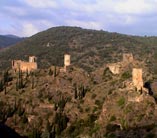
The four Chateaux de Lastours.
Cabaret, Tour Regine, Surdespine and Quertinheux all four built
on the same rocky promontory, together controlled access into
the Carbardes from the 11th century up to the French revolution
1789. |
|
|
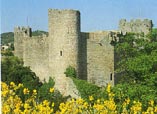
The Chateau de
Villerouge-Termenes. Owned by the Archbishop of Narbonne, it
became the property of Simon de Montfort when the castle at
Termes surrendered in 1210. |
|
|
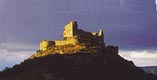
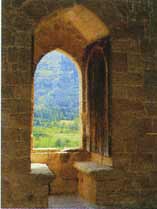
The Chateau d'Aguilar. The
ruins of the castle , standing on top of a rocky summit, consist
of a high polygonal perimeter wall that narrows to a point
on the vulnerable approach. |
|
|
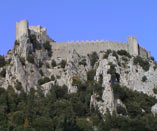
The Chateau d'Arques. The
chateau is believed to date from the latter part of the 13th
century, as the region immediately surrounding Arques has
sheltered Cathar perfecti since the end of the 12th century. |
|
|
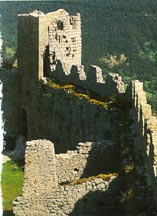
The Chateau de Peyrepertuse.
Forming the largest ensemble of fortifications of its type in
the Languedoc region, it also offers the finest example of
medieval military architecture in the region. |
|
|
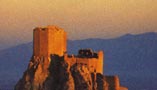
The Chateau de Puilaurens.
Consists of a keep, modified and enlarged in the 11th and 12th
centuries, within a walled enclosure on top of a rocky spur that
blocks off the valley. |
|
|
The Chateau de Queribus. This
13th - 14th century castle was the last stronghold to succumb to
the crusaders (1255), it was converted by the central monarchy
into a royal fortress to stand guard over the Spanish marches
until 1659. |
|
|
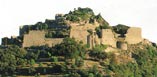
The Chateau de Termes. In
the 13th century, this castle was a Cathar stronghold, resisting
siege during the Albigensian Crusade for four months. |
|
|
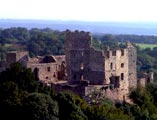
The Chateau de Saissac.
Castle of medieval origin, with vast quadrangular defensive wall
dominated by the remains of a polygonal dungeon. |
|
|
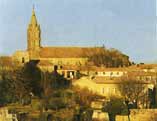
The Cite of Fanjeaux.
Standing at 360 meters altitude, this historic village offers a
panoramic view over 7 French departments. In the 14th century it
grew into a medieval stronghold with a population of 3000. |